A warehouse can look orderly from the aisle and still hide a poor storage decision. One overloaded beam, a blocked sprinkler, or a forklift turning too tightly can change the risk. Warehouse Racking is the structural system that stores palletized goods vertically and keeps them accessible. Its design affects capacity, picking speed, and day-to-day safety.
The U.S. Bureau of Labor Statistics’ 2023 workplace injury report tracks transportation and warehousing separately, a reminder that storage operations deserve careful risk controls. MHI’s 2024 Annual Industry Report also examines technology investment and changing supply-chain operations. Together, these sources frame an important point: rack selection should fit actual inventory, equipment, and workflow—not just the available floor area. The Rack Manufacturers Institute’s ANSI MH16.1 standard provides technical requirements for industrial steel storage racks. Operators should also follow the rack manufacturer’s load plaques and inspection guidance.
Supply-chain scholar Yossi Sheffi, author of The Power of Resilience, emphasizes designing operations to withstand disruption. That principle applies to warehouse layouts, where a small change in inventory or traffic can affect performance. Selective, drive-in, push-back, pallet-flow, and cantilever systems each solve different storage problems. The best choice depends on pallet dimensions, stock rotation, aisle width, and handling equipment. It is tempting to treat capacity as the only measure. It is not. A practical assessment should include installation quality, damage checks, and future changes in product mix. Even a well-designed rack needs attention. That part is easy to overlook.
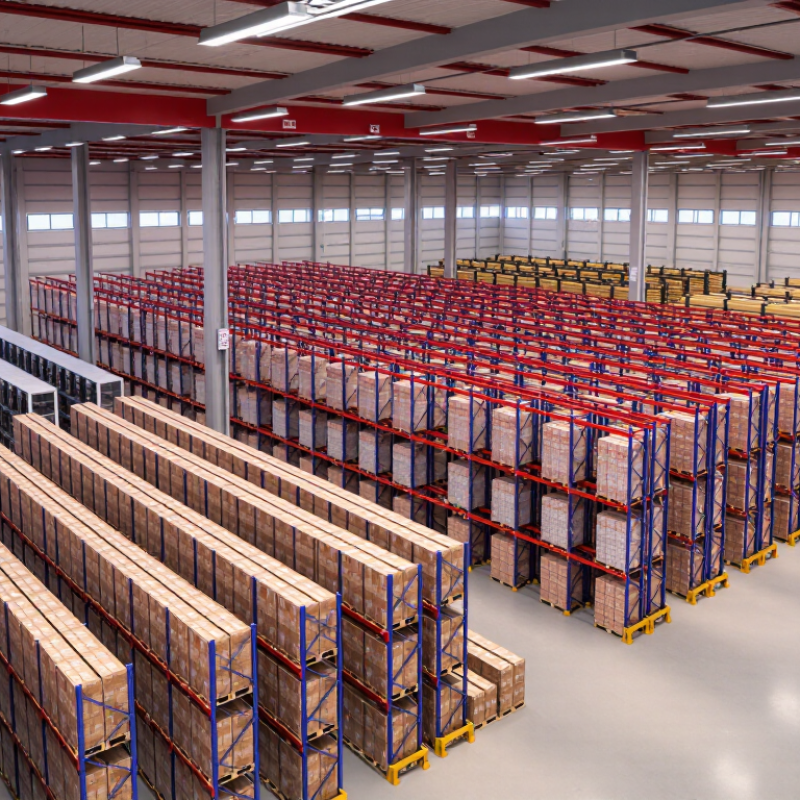
Warehouse racking is a load-bearing framework that stores goods above the floor. It helps warehouses use vertical space while keeping products organized and accessible. Instead of placing every pallet on the floor, workers can store labeled loads on beams at set heights. This can make stock easier to locate and help forklifts move through planned aisles. A rack also separates products by size, destination, or handling needs. Small details matter: a bent upright or overloaded beam can create a serious hazard. Racking is useful only when its layout suits the goods and equipment.
In daily operations, staff use racks to stage incoming pallets, hold reserve inventory, and replenish picking areas. Clear labels and open aisles help workers identify loads and avoid unnecessary handling. That matters. The U.S. Bureau of Labor Statistics’ 2022 workplace injury and illness data reported 4.8 recordable cases per 100 full-time workers in warehousing and storage. This figure is not specific to racking, but it highlights why safe access and routine rack checks deserve attention. Rack plans can also become outdated when products or forklifts change. A tidy installation is not automatically a safe one. A rack is not a cure-all; poor load placement can still waste space and complicate work.
Warehouse racking is a storage system that uses upright frames and horizontal beams, or other supporting structures, to store goods vertically. The right system depends on the load, inventory rotation, available space, and required access.
| Racking type | How it works | Common use | Selectivity and access | Space-use profile | Key consideration |
|---|---|---|---|---|---|
| Selective pallet racking | Pallets are stored on beams in rows, with an aisle allowing forklift access to each storage position. | Warehouses handling many product lines or frequent order picking from pallets. | High: each pallet can generally be accessed directly. | Lower density than systems that reduce aisle access, but straightforward to configure. | Requires operating aisles; layout must suit the handling equipment. |
| Double-deep racking | Pallets are stored two positions deep, typically using a reach truck with an extended reach or pantograph attachment. | Operations with several pallets per product and fewer product lines than a highly mixed inventory. | Medium: the front pallet must be moved to reach the pallet behind it. | Higher storage density than single-deep selective racking. | Needs compatible equipment and inventory practices that account for the less accessible rear position. |
| Drive-in racking | A forklift enters a supported storage lane to place or retrieve pallets. Lanes are commonly accessed from one end. | Large quantities of similar products stored in batches. | Low to medium: pallets within a lane are less directly accessible than in selective racking. | High density because fewer aisles are needed between storage lanes. | Forklift travel inside lanes requires careful operation; suitable load handling and lane design are essential. |
| Drive-through racking | A forklift can enter a lane from either end, allowing loading from one side and retrieval from the other when the layout supports it. | High-volume, similar-product storage where a through-lane arrangement is practical. | Low to medium: lane access is shared, though both ends can be used. | High density, with access aisles at both ends of the lanes. | A two-ended layout can support product flow, but does not by itself guarantee first-in, first-out handling. |
| Push-back racking | Pallets sit on nested carts or rollers in an inclined lane; adding a pallet pushes the previous one farther back. | Multiple pallets of the same product stored by lane, often where compact storage is important. | Medium: typically accessed from the front, with pallets retrieved in last-in, first-out order within a lane. | Higher density than selective racking by reducing the number of access aisles. | Pallet condition, load consistency, and system maintenance affect reliable movement. |
| Pallet flow racking | Pallets move by gravity along inclined roller tracks from the loading face to a separate picking face. | High-throughput storage for products that benefit from a first-in, first-out flow. | Lane-based: the next pallet advances to the retrieval face as the front pallet is removed. | High density with distinct loading and unloading aisles. | Pallet specifications, load stability, and flow-control components must suit the application. |
| Cantilever racking | Horizontal arms extend from upright columns to support long or irregular items without front-facing shelf uprights. | Long goods such as timber, pipes, metal sections, and furniture components. | Good access to stored items from the open front, subject to the chosen layout and handling method. | Flexible for long loads; space needs depend on item length and handling equipment. | Arm, column, and base design must be matched to load dimensions and weight. |
| Carton flow racking | Cartons or totes travel forward on inclined flow tracks from a replenishment side to a picking side. | Piece-picking operations with repeated access to cartons or small containers. | Good picking access at the front; lanes are generally arranged for first-in, first-out replenishment. | Uses vertical and lane space efficiently for small-item picking. | Track width and product packaging need to allow smooth movement without jams. |
| Mobile racking | Racking runs are mounted on powered or manually operated mobile bases that move to open an access aisle where needed. | Storage areas where high capacity is needed and access can be provided to one aisle at a time. | Direct access is available after the required aisle is opened. | High density because fewer permanent aisles are needed. | Requires suitable flooring, safety controls, and consideration of access time and operating procedures. |
It stores goods above the floor and uses vertical space. Labeled pallets on beams can be easier to find and move.
Staff can stage incoming pallets, store reserve stock, and replenish picking areas. Clear labels and open aisles reduce unnecessary handling.
Record pallet sizes, weights, daily picks, and seasonal peaks. Note which products move quickly and which may sit for weeks. Measure twice.
Selective racks give forklift access to each pallet but need aisle space. Denser systems store more pallets, though access may be slower.
Carton-flow shelving can support picking small, fast-moving items. Cantilever arms may suit long or awkward materials.
Check ceiling height, columns, floor capacity, sprinkler clearance, and forklift turning space. A loading door can complicate a layout that looks fine on paper.
Accurate pallet weights and dimensions help a qualified designer plan suitable beams and rack dimensions. Guessing can lead to poor fit or unsafe loading.
Test a small section with actual pallets and forklifts. A drawing can miss a tight turn. Revising it may be inconvenient, but useful.
Look for bent uprights, overloaded beams, blocked aisles, and damage. A tidy installation is not automatically safe. Keep room for inspection and repairs.
Warehouse Racking is a system of frames and beams designed to store goods vertically and make better use of warehouse space. By organizing products into accessible locations, it can support smoother inventory handling, improve picking efficiency, and help businesses manage different storage needs. A typical system includes upright frames, horizontal beams, connectors, and protective features, with its layout and load capacity determined by the items being stored and the equipment used to move them.
Common options include selective, drive-in, pallet-flow, and cantilever racking, each suited to different products, access requirements, and storage volumes. Choosing a system involves considering available space, inventory turnover, load dimensions, handling equipment, and plans for future changes. Safe operation also depends on using racks within their rated capacity, keeping aisles clear, training staff, and regularly checking for damage or loose components. Timely repairs and consistent maintenance help preserve stability and reduce the risk of accidents.

 Jracking